|
|
The Later Roman Army - An overview
| |
The army of the later Empire has had a bad
press, being widely regarded as a motley collection of half trained
, poorly equipped, incompetent peasant farmers associated with increasing
numbers of Germanic barbarians whose very presence diluted and degraded
the once proud Roman military machine.
This was an army that, even with its vastly increased numbers, proved
ultimately incapable of preventing the destruction of the Empire,
so it clearly cannot have been anywhere near as effective as its
early Imperial counterpart, or so the theory runs.
In any case, the later Empire was, as Gibbon saw it, a period
of decline and fall, and the army must surely have shared in the
general degeneration of Roman life and society.
Actually, this is to misunderstand both the nature and ethos of
the later army and that of the society of which it formed a part.
The fourth century world may have been very different from that
of the Julio-Claudians but that difference does not necessarily
imply decline. Such moral judgements seem inappropriate. First century
society was not intrinsically 'better' than fourth century society
(one only has to think of Britain's fourth century villas and their
mosaics) and the later Roman army was just as effective in pursuing
the defensive goals for which it was designed as its earlier counterpart
was in fulfilling Rome's expansionist mission.
In fact, the main reason for the evolution of the later military
system was precisely because the early Imperial army had proved
incapable of dealing with the changed conditions and the new threats
to the Empire which emerged during the later second and third centuries.
Had the system not adapted to change, the Empire would undoubtedly
have collapsed considerably earlier than it actually did.
Obviously the later army doesn't seem
to compare very favourably with the expansionist force of earlier
days since by its very nature it was a defensive army and
defensive armies do not seem to hold much glamour. In addition,
in appearance there is no doubting that it seems to have more in
common with the Bayeux tapestry than with Trajan's column and one
cannot argue with the fact that this has much to do with the increasing
proportion of 'barbarian' troops serving Rome in the fourth century.
Yet appearances can be deceptive:
- A defensive army is not necessarily incompetent
or weak - how expansionist is the British army today?
- Developing 'barbarisation' does not
necessarily imply a decline in standards - even the much derided
frontier troops or 'limitanei' were capable of putting up stiff
resistance when the occasion arose, the commissariat was
still able to organise the provision of military supplies on a
colossal scale while so-called barbarian troops proved disciplined,
skilled and conspicuously loyal in their service to the Roman
state.
- In fact, the recruitment of soldiers from
beyond the frontiers was only the culmination of a long-standing
Roman tradition of employing the fighting skills of others to
their advantage and it is hard to see where sufficient fighting
men of the right quality could have been obtained in an Empire
which by this time may well have lost much of its fighting edge
thanks to its success in spreading the benefits of civilisation
and which may well have been experiencing demographic problems.
In any case, they did not become preponderant until the very end
of the fourth century.
- Lack of body armour may make later Roman
troops appear 'primitive' next to their earlier counterparts,
but this only represents the normal fighting kit of troops from
beyond the frontiers which then spread to those recruited from
within the Empire. This does not mean that the later Empire was
somehow in terminal technological decline - artillery was still
very much in use at this time, while heavily armoured cavalry,
the cataphracti and clibanarii , were employed in
field armies throughout the Roman world and testified to the continuing
skill of Roman armourers.
Evolution of the Later Roman Army
The later Roman army was in many respects simply
the evolutionary successor to the army of the Principate - it had
always been an adaptable, changing force- yet it is also clear that
the century between the death of Severus (211) and that of Constantine
(337) had a particularly profound effect on almost all aspects
of military life and organisation, dramatically accelerating trends
which had hitherto only been proceeding slowly.
This was a time of crisis for the Roman Empire, when many of the old
certainties of the classical world were swept away by barbarian invasion,
repeated usurpation, rampant inflation and political separatism in
both East and West. The Empire only survived by dramatically reordering
itself, emerging in the fourth century as an overtly absolutist military
monarchy, with an administration of almost 'Byzantine' complexity
and an ethos more Mediaeval than classical. Unsurprisingly, the army
shared these changes to the full. |
|
|
|
|
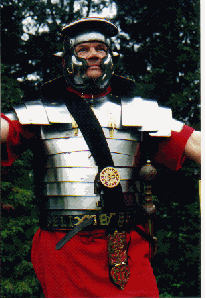
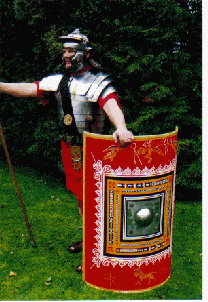
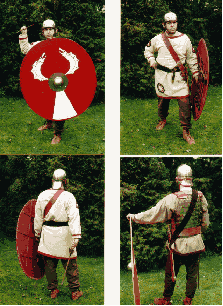
A soldier of the third century-
last of the recognisably 'Roman' Imperial troops.
All equipment researched and manufactured by the Roman Military
Research Society
|
| |
Changing Ethos and Strategy.
- First Century
The ethos of the army of the Principate
had been one of aggression and expansion. Problems on the
frontiers were dealt with by military action, often resulting
in conquest, and any Emperor worth his salt was expected to be
a "Propagator Imperii". Legionary bases and auxiliary forts were
simply temporary winter quarters for mobile, offensive armies,
and the confident belief was that, sooner or later, the Pax Romana
would embrace the entire world.
One of the first cracks in the confident outlook
of divine mission came with the Clades Variani of AD 9 when 3
legions and associated auxiliaries were massacred in the Teutoberger
Wald by Germanic barbarians. Clearly, Roman arms were not necessarily
invincible, and although further conquests were made, Roman expansion
began to slow down. The world outside the Mediterranean basin
was looking increasingly unattractive and valueless and Rome was
now in any case close to the natural limits of expansion that
could be supported by her existing economic and administrative
resources.
- Second Century.
Gradually, momentum dwindled, temporary halting
places hardened into stone built fortresses, the 8 legions poised
on the Rhine to overrun 'free' Germany were reduced to
6 and then to 4, and the limits of advance crystallised into
fixed frontiers, delimited first by roads, these then becoming
festooned with watchtowers and palisades and finally, in some
places, stone curtain walls. The word 'limes' which had once
meant a road into enemy territory now came to mean a
frontier parallel to enemy territory. Conquest was turning
into consolidation and aggression into protection.
This is not to say that
the Romans were hiding behind these frontier works. Far from it,
in fact, since the basic military strategy was one of preclusive
security, to exclude the enemy from Roman territory completely.
This was achieved by maintaining effective intelligence gathering
beyond the frontiers thereby facilitating rapid deployment of
the auxiliary forces stationed along the frontier line and of
the legions located somewhat further back with the aim of confronting
the enemy on their territory, well beyond the limits of
direct Roman control. (This is assuming, of course, that the often
preferred diplomatic option was not being pursued).
Although preclusive security remained the
ideal down to Diocletian and beyond, the varying threats to Roman
territorial and political integrity which emerged in the third
century made this an increasingly unattainable goal. At the same
time as Rome dissipated her energies in civil war, her enemies
beyond the frontiers were growing ever more powerful, with the
revived Persian Empire inflicting a series of humiliating defeats
in the East and, in the West, new confederations of barbarians
such as the Germanic Alamanni (or 'all men') and Franks making
damaging inroads into Roman territory, one of the worst being
in 276 when perhaps 70 Gallo-Roman cities were plundered and devastated.
Such incursions occurred with alarming
regularity along the length of the frontiers during this period,
revealing the inability of the existing military arrangements
to cope with the new situation. Legions and auxiliaries had put
down roots and become relatively static; once the barbarians had
broken through the relatively thinly held frontier line, there
was nothing to prevent them from plundering soft targets in the
interior provinces at will. The massive walls of Aurelian, built
in the 270's to defend Rome herself, are eloquent testimony to
the new insecurity.
Yet a new approach was developing. Third century
Emperors spent little time at Rome, often originating in frontier
provinces and spending most of their careers where the action
was. Naturally enough they tended to take their court around with
them and attached to this was the comitatus or 'companions',
at first (perhaps under Gallienus in mid-century) an assemblage
of cavalry units possibly intended to form a highly mobile central
reserve which would enable the Emperor to respond rapidly to any
new incursions (or usurpations?) that might arise This may well
mark the first stirrings of a new military strategy for the Empire.
- Fourth Century.
Some historians believe that Gallienus' force
represents the precursor of the mobile field armies of the fourth
century, later developed by Diocletian but brought to full fruition
during the reign of the Emperor Constantine. Diocletian was certainly
a crucial agent of recovery, responsible for restoring Rome's
frontiers, but it appears to have been Constantine who finally
abandoned the old idea of preclusive security in favour of a more
flexible frontier-in depth approach to frontier control.
- Later Roman Military organisation.
Constantine spent much of his reign in military
conflict, and out of his experience was "forged the New Model
Army of the Later Roman Empire". Gone was the traditional division
between legionaries (citizen heavy infantry) and auxiliaries (
non-citizen light infantry and cavalry) , to be replaced by a
new distinction between the elite troops of the Emperor's mobile
field army, the comitatenses and the lower status ( though
not necessarily less effective) limitanei or frontier troops.
- The Field Army
The Constantinian field army of comitatenses,
first officially recorded in 325, comprised both cavalry
and infantry under new commanders known as the Magister Equitum
and the Magister Peditum.. At this stage it retained
its close physical link with the person of the Emperor,( although
it should not be confused with the elite units of the Imperial
bodyguard, the Scholae Palatini) but very quickly it
became obvious that the extent of the Empire meant that one
central force could not deal effectively with simultaneous threats
on several fronts.
The result was that we find detachments of comitatenses being
stationed away from the Emperor and turning into regional field
armies , the most significant being those of Gaul, the East,
and Illyricum. These were mobile troops who were not based in
permanent forts, but usually billeted in towns, a local rapid
reaction force ready to respond to any barbarian threat on their
'patch'. They were commanded by professional soldiers known
as 'comites' or counts, now that the old provincial governors
had lost their military powers, and they proved
a credible and effective response to the needs of the time
|
|
|
|
|
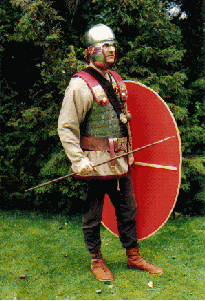
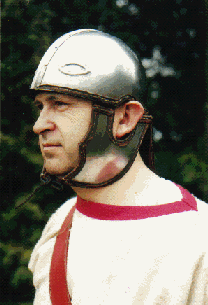
A mean looking member of the elite comitatenses
- Lugubrius of the Hermanduri
|
- The Frontier Troops
The limitaneiwere largely composed of the old legions and auxilia,(
though the former seem to have been reduced in strength to units of 1,000
or so) with an admixture of newer units such as numeri and cunei, created
during the troubles of the third century. They were also no longer commanded
by individual provincial governors but by a regional Dux (such
as the Dux Britanniarumfound in the Notitia), a professional
soldier, responsible for co-ordinating frontier defence in his area and
liaising with his immediate superior, the comesof the regional
field army.
The old view that the limitaneiwere some kind
of ineffectual peasant militia, bound to the soil, does not seem to be
borne out by the evidence : units of limitaneiwere, on occasions,
drafted into the field army as pseudocomitatenses and even
in their primary function of frontier defence, they were capable of performing
sterling service, as at the siege of Amida in 359, related by Ammianus
Marcellinus. They may not have received the best recruits, but, as Southern
and Dixon state, "this should not suggest that there were no standards
at all. The units were still organized and the procedure for enrolment
and recruitment was still properly carried out". In any case, as they
point out, if they were that bad, why didn't any late Roman Emperor do
something about the problem?
- Defence in depth
In any case, they were essential to the new system
of Imperial defence. Rome now recognised that preclusive security could
not be achieved; instead the assumption was that the barbarians would
be able to penetrate Roman territory, and it was on Roman territory
that they would be dealt with.
The presence of the limitanei was intended to deter invasion
in the first place, but if it did happen, their role was to slow down
the enemy advance and to siphon off their troops by holding newly constructed
strongpoints known as 'burgi' ( which also acted as resupply stations
for the mobile field army), fortified towns and other heavily fortified
military sites along lines of communication. This would help protect
the local populace, deny food to the invader, and most importantly,
slow down enemy penetration, giving the field army time to arrive and
confront them in open battle.
|
|
|
|
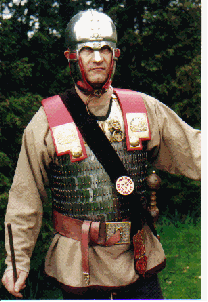
The fetching apparel of a limitaneus (and an
intrusive Comitatensis back view). Arbogastes of the Alamanni
|
This was a strategy which by and large worked, and the Romans were quite
capable of defeating superior numbers, such as in the Emperor Julian's
great victory over the Alamanni at Strasbourg in AD 357. It may well
be represent a more defensive posture than had been the case in earlier
centuries, as reflected in the heavily fortified nature of late Roman
military installations, but this was an active rather
than a passive form of defence which served Rome well during a period
of recurrent crisis. If the Roman Empire in the West finally gave way
to the successor states in the fifth century, this has more to do with
ineluctable social, cultural and economic change than with any failure
of Roman military capabilities.
|
Further Reading
|
|
| Primary Sources : |
|
| Ammianus Marcellinus, 'Histories '
|
The only decent historian since Dio Cassius |
| Anonymous 'De Rebus Bellicis' |
Plans for army reform addressed to Valentinian
I |
| Historia Augusta |
Histories of third century emperors,
of dubious reliability |
| The Notitia Dignitatum |
Late Roman government civilian and military
handbook |
| |
'Epitoma ReiMilitaris' - looks back to
the good old days |
| |
but still useful for later army |
| |
|
| Secondary Sources: |
|
| A. Cameron |
The Later Roman Empire |
| BT Cornell and J. Matthews |
Atlas of the Roman World |
| P. Connolly |
Greece and Rome at War |
| A.Ferrill |
The Fall of the Roman Empire, the Military explanation |
| S. Johnson |
Later Roman Britain |
| A.H.M. Jones |
Constantine and the conversion of Europe |
| A.H. M. Jones |
The Decline of the Ancient World |
| A.H.M. Jones |
The Later Roman Empire |
| E.M. Luttwak |
The Grand Strategy of the Roman Empire |
| R. Macmullen |
Constantine |
| R. Macmullen |
Soldier and Civilian in the Later Roman Empire |
| Pat Southern and Karen Dixon |
The late Roman Army. |
| S. Williams |
Diocletian and the Roman Recovery |
|