
|
|
|
|
Gender is not a fixed bodily state, but a shifting cultural
grouping in which biological sex may or may not be a seminal factor; and
the assignment of individuals into cultural categories is largely determined
by socially hierarchical differences. These ideas may seem difficult to
grasp now, since the modern preference is to divide humanity into two
natural kinds: female and male. As a concept, this would have seemed strange
to many Romans. Simone de Beauvoir’s famous dictum that “one is not born
a woman, but rather becomes one” may be much closer to Roman thinking.
Indeed gender in the Roman world was more intimately bound with notions
of social identity and, through this, the relationships of power. For
slaves, the concept did not apply as Roman law made no distinction between
male and female and thus, slaves were ‘genderless’.
To explain Roman views, let us first look
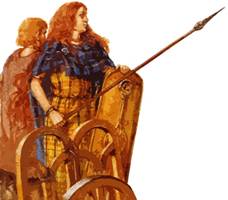
at the infamous case of Boudicca, beginning with trying to envisage
the ‘woman’ behind the centuries of myths and legends. Boudicca,
wife of Prasutagus chief of the Iceni tribe who had been
established as a client king of Rome after 47 CE, was herself descended
from a royal house, although which one is not recorded. Boudicca
was believed to be in her thirties when her husband died, bequeathing
his estate jointly to his two daughters and the Emperor Nero in
an effort to retain a modicum of Icenian independence. It is important,
for the purposes of distinguishing social norms, that there was never
any suggestion Boudicca did not have a right to her husband’s throne
in her own name. “Nor did she subsequently claim the
throne for herself but acted on behalf of her daughters, whose rights
were recognised by the Iceni, if not by the Romans”
(Allason-Jones, 1998). Tacitus’ version of events lets Boudicca herself say that the Britons were used to women leaders, and imply that while the British men might be happy to settle for enslavement, at the end of the day, she would suffer a far nobler fate. A woman leading in a war would remind Tacitus’ readers of the Amazons whom, as far as the Romans were concerned, were as far from being civilised as was possible. For Tacitus, therefore, the Briton’s are contrary people who do everything the opposite of Rome. But he also records Boudicca’s suicide in defeat as a parallel to that of Poenius Postumus, who was dishonoured in the victory by his refusal to reinforce his colleagues, and thus blurs the male/female distinction. Cassius Dio comments that whole disaster of the rebellion had an extra shame for the Romans since it was perpetrated by a woman, but he softens the dreadfulness of this by permitting her to be an exceptional woman in terms of spirit and looks: “In stature she was very tall
and grim in appearance, with a piercing gaze and a harsh voice”.
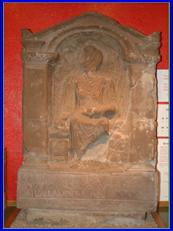
His description resonates with the veiled suggestion that Boudicca was very masculine in her bearing. This despite Tacitus’ emphasis that she fights to avenge Roman crimes against her comrades and not as a queen. From each of the literary portraits of Boudicca, we begin to see how and why they have been carefully constructed by the writer. In the Annals of Tacitus, for example, the wider background themes deal with justice and the proper practices of an ordered society. While extolling liberty and servitude, Tacitus warns of the abuse of such ideals and the predictable violent consequences. In doing so, he espouses what constitutes civilization and barbarity. Tacitus portrays Boudicca as a sympathetic victim, wanting nothing more than to avenge the injustices inflicted upon her, her daughters and her community and is perceptive enough to point out that Boudicca is not just a queen but also a wife wronged by the worst parts of Roman imperialism. He stresses the unrestrained and disproportionate nature of Roman violence and raises questions for his readers on just who was the ‘civilized society’ during these events. Tacitus seemingly links Roman political themes into this clearly British setting by minimizing the “native” element in his picture of the Iceni Queen. Yet, Boudicca’s speech to her troops before the battle is an obvious plot device by Tacitus to explain how normal it was for women to lead Britons to war. Her actions, although unexpected by the Romans, uphold rather than transgress the social norms for a British woman. More typical than the Boudiccan example of how Romans perceived gender is revealed by Regina’s famous tombstone. The complex image depicts Regina sitting in a high backed chair, her distaff and spindle in her lap, a wool basket by her left side, and with her right hand she holds open a jewel box; she is adorned with bracelets and wears a necklace. The image is highly symbolic of the typical Roman matron and of traditional values - the distaff and spindle suggestive of homespun clothes (although in reality, it is unlikely that higher status Romans made their own clothes).
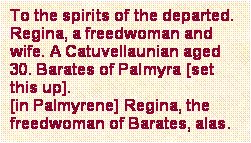
Of singular importance in terms of understanding gender
and social roles is the bilingual inscription (see inset) that reveals
a cultural interaction in Romano-Britain and its impact on identity. Regina
is clearly someone who has experienced both slavery and freedom, although
it is difficult to see how she became a slave in the late second century,
the date attributed to the tombstone. It is entirely possible that she
was sold into slavery by her parents. Despite the practice being against
the law, evidence from across the Empire suggests that it was common for
families to sell their daughters if they could not afford to raise them.
Apart from relief for poverty stricken families, it may also have been
felt worth the risk if a young girl could attract her master’s attention,
who may, hopefully free and then marry her. Submission to enslavement
is similarly evidenced in post-Roman Gaul where people in debt could place
themselves in bondage until the debt was paid off - the origin of serfdom.
Interestingly, the inscription offers no clue that Regina obtained
Roman citizenship on her manumission and, given her husband’s single name,
lends weight to the suggestion that he also was not a Roman citizen. If
Barates, as his own tombstone states, was an iterant seller of flags,
serving the far flung outposts of the Empire, it is quite reasonable that
Regina shared his hard life on the road. With no explicit mention
of children, the fact she is buried in the manner of a Roman Matrona
offers several interpretive possibilities. Perhaps she aspired to such
status, but never achieved it in life. Perhaps Barates sought to
honour his beloved wife by providing a memorial befitting a high-status
Roman matron in recognition of her aspiration. Perhaps, the couple genuinely
achieved the social status depicted or perhaps Barates was conventionally
pious and followed the norms of his age. Or perhaps, the monumental mason
carved a standard tombstone following the expected or locally conventions
for women in Arbeia, providing her family could afford it. 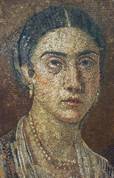 Mosaic of a matrona exemplifying Roman virtues. Regina’s tombstone certainly indicates the cultural diversity present in Romano-Britain. Here we see a British woman from St. Albans, born of the Catuvellauni, married to a merchant from Palmyra and eventually buried in a Roman style tomb. As neither Regina nor Barates were citizens, it is indicative of people from all over the Empire choosing to become “Roman” while preserving their own cultural traditions - the final part of the inscription written in Barates’ mother tongue is a fine example.
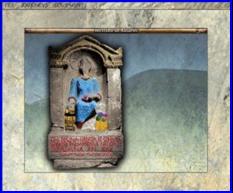
Regina’s memorial, this time painted as was probably common for such funerary monuments. The examples of Boudicca and Regina are useful contrasts that offer insights into Roman views of gender and social roles.. Regina’s tombstone portrays a paragon of Roman virtue, albeit while preserving her cultural identity. Boudicca, on the other hand, is represented as the barbarian who does not accept Roman ways and is, therefore, an outsider. In this brief look, we can begin to appreciate that “gender…speaks constantly in the languages of age, status, ethnicity, and they in the language of gender; it exists only and always in relation to other social categories. And power can only be understood as it is generated through these complexes of categories” (Kampen, 1996, p 14). As with modern perceptions, social identity in the Roman world was an intricate matter; people defined themselves with multi-faceted aspects, influencing their family, friends and associates in many synchronized ways. ‘Male’, ‘female’, ‘Roman’ and ‘Briton’ are all relative terms without an essentially fixed nature and their definition was reliant on an individual’s role in society and their subsequent behaviour. It is not surprising then that Longinus from Bulgaria can be styled a Roman soldier in his memorial, and the barbarian ‘Queen’ Boudicca can be seen as acting with greater respect and masculinity than her Roman opponents. |
|||||||||||||
| References:
Allason-Jones, L. (1998), Women in Roman Britain, British Museum Publications. Kampen, N.G. (1996), Gender theory in Roman Art, in Kleiner, D.E. and Matheson, S.B. (Eds), I Claudia: Women in Ancient Rome, New Haven, Conn. Yale University Art Gallery.
|
|
©RMRS 2010
|
||||||||||