and South Shields Auxiliary Fort
between AD c.150 and c. 250.
Jessica Billing<
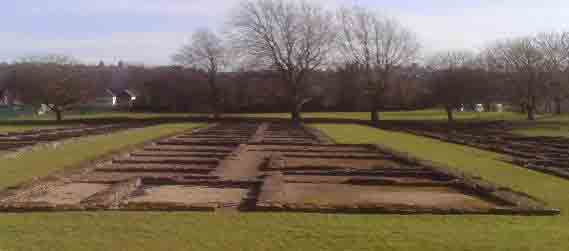 The foundations of one of the barrack blocks at Caerleon legionary fortress Please click on the image to view the full article (A 2.4 Mb pdf file) |
|
|
Abstract
Few Roman military studies have been concerned with comparing life, and the activities taking place within, different fortresses and forts; despite evidence of variation between sites (Birley 1976: 271, Baker 2004: 61). This dissertation compares and examines, through the use of dimensional data and plans, the adornment of the principiae and Caerleon thermae, and the activities taking place within them. Many ideas about the function of principiae are open to conjecture, being based only on Roman texts and a small number of excavations (Bidwell 2007: 72, Johnson 1983: 111). This study also compares small finds data from each site, and employs the use of functional groupings to analyse this statistically in order to make interpretations about past activity. The results indicate that, perhaps, no two Roman military sites functioned in quite the same way; evidence of the regulation of civilian entrance and heavier patrolling of the ramparts was found at Caerleon, and a distinct absence of items associated with females was found at South Shields. In addition, the barrack blocks were compared and the results illustrate the key organisational role and high status of the legionary centurion. Furthermore, it is supposed that Caerleon thermae would have looked similar to the interior of present day York Minster. Overall, the results of this dissertation indicate that in order to better understand life, and the activities taking place within Roman military sites, they need to studied individually and compared with one another. |
|