| Reclaiming Ancient symbols |
 Pvdens (Mark Hatch) |
| Mention the word ‘swastika’,
or worse, draw the image and today you risk causing offence for
many varied reasons. Though once commonly used over much of the
world without stigma, because of its iconic usage in Nazi Germany
the symbol remains highly controversial in the Western world. Any
discussion on Roman symbology cannot, and must not (lest we condemn
ourselves to make the same mistakes), divorce itself from its modern
connotations. However, perhaps it would be appropriate to return
this symbol to its more benign ancestry and, with education, over
time deny its use to ‘extremists’. That’s the aim
- now how to navigate the minefield..? A ‘swastika’ is normally taken to refer
to an equilateral cross with its arms bent at right angles, which
appears either right-facing ( ) or in its mirrored left-facing
( ) form. Archaeological evidence of swastika-shaped ornaments
dates from the Neolithic period. As an ancient symbol, the swastika
occurs mainly in the cultures that reside in modern day India
and the surrounding area, sometimes as a geometrical motif (as
in the Roman Republic and Empire) and sometimes as a religious
symbol. It has long been widely used as a sacred symbol in world
religions such as Hinduism, Buddhism, Jainism (see insert), and
Mithraism. The major religions, with a total of more than a billion
adherents worldwide, make the swastika universally found in both
historical and contemporary society. Etymology. The word swastika is derived from the Sanskrit word svastik meaning any lucky or auspicious object, and in particular a mark made on persons and things to denote good luck. It is composed of su-, meaning "good, well" and asti, a verbal abstract to the root as "to be". Svasti thus means "well-being." The suffix -ka intensifies the verbal meaning or confers the sense of 'beneficial', and svastika might thus be translated literally as "that which is associated with well-being," corresponding to "lucky charm" or "thing that is auspicious."[1] The Hindu Sanskrit term has been in use in English since 1871, with alternative historical spellings including suastika, swastica and svastica. |
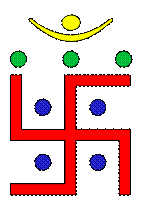 Jainism is a religion that
originated in the Indian subcontinent. Jainism is often referred
to as Jain Dharma or Shraman Dharma by its practitioners.
|
| Origin Hypotheses.
The ubiquity of the swastika symbol is easily explained by it being a very simple shape. Many basket-weaving society, for example, have independently arrived at a repeating swastika design using the edges of the reeds in a square basket-weave. Regardless, the genesis of the swastika symbol is often treated in conjunction with cross symbols in general, such as the "sun wheel" of Bronze Age religion (see opposite). History. As already alluded to, the earliest consistent use of swastika motifs in the archaeological record is dated to the Neolithic. For example, the symbol has been found on a number of shards in the Khuzestan province of Iran and as part of the "Vinca script" of Neolithic Europe of the 5th millennium BC. In the Early Bronze Age, it appears on pottery found in Sintashta, Russia. Swastika-like symbols also appear in Bronze and Iron Age designs of the northern Caucasus (Koban culture), and Azerbaijan, as well as of Scythians and Sarmatians. In all these cultures, the swastika symbol does not appear to occupy any marked position or significance, but seems to be just one form of a series of similar symbols of varying complexity. |
 Bronze age ‘sun wheels’.
|
|
Endnotes: |
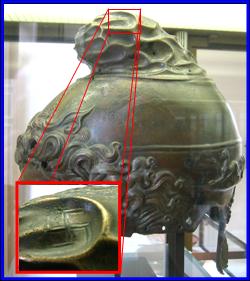 Greek helmet with swastika marks on the top part (details), 350-325 BC from Taranto, found at Herculanum. |
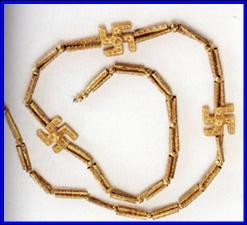
This first millennium BC
Iranian necklace was excavated from Kaluraz, Guilan. (National
Museum of Iran)
|
|
 An iconic reviled image concealing the symbols benign origins. |
|
|
|